Publications

My research focuses on computational geometry, additive manufacturing, and robotics. Below is a list of my publications. You can also find my articles on my Google Scholar profile.

First Author (Co-first Author)

Neural co-optimization of structural topology, manufacturable layers, and path orientations for fiber-reinforced composites

Published in ACM Transactions on Graphics (TOG), 2025
Tao LIU, Tianyu Zhang, Yongxue Chen, Weiming Wang, Yu Jiang, Yuming Huang, Charlie Wang

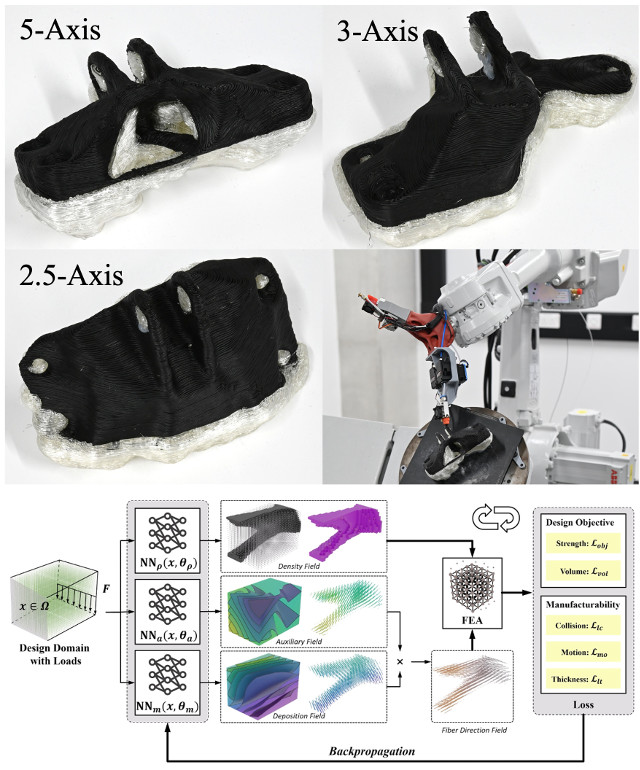
Neural co-optimization of structural topology, manufacturable layers, and path orientations for fiber-reinforced composites

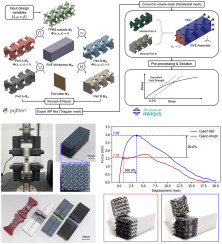
We propose a neural network-based computational framework for the simultaneous optimization of structural topology, curved layers, and path orientations to achieve strong anisotropic strength in fiber-reinforced thermoplastic composites while ensuring manufacturability. Our framework employs three implicit neural fields to represent geometric shape, layer sequence, and fiber orientation. This enables the direct formulation of both design and manufacturability objectives - such as anisotropic strength, structural volume, machine motion control, layer curvature, and layer thickness - into an integrated and differentiable optimization process. By incorporating these objectives as loss functions, the framework ensures that the resultant composites exhibit optimized mechanical strength while remaining its manufacturability for filament-based multi-axis 3D printing across diverse hardware platforms. Physical experiments demonstrate that the composites generated by our co-optimization method can achieve an improvement of up to 33.1% in failure loads compared to composites with sequentially optimized structures and manufacturing sequences.
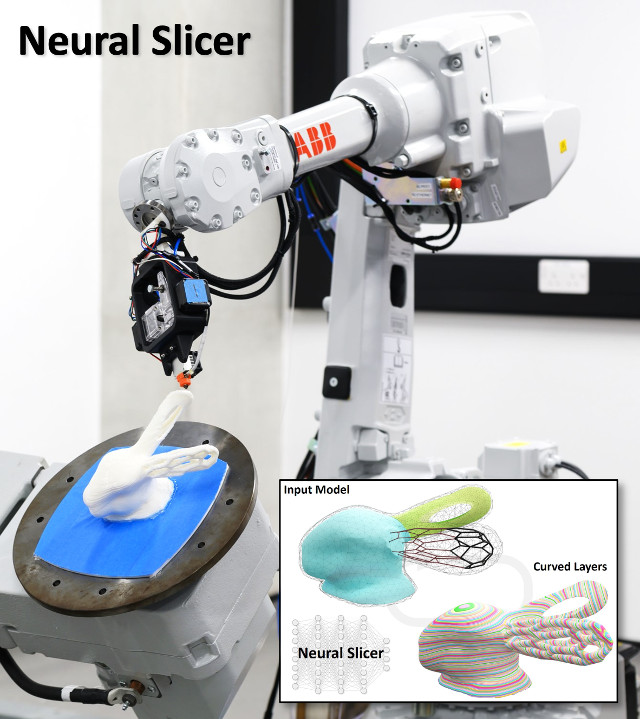
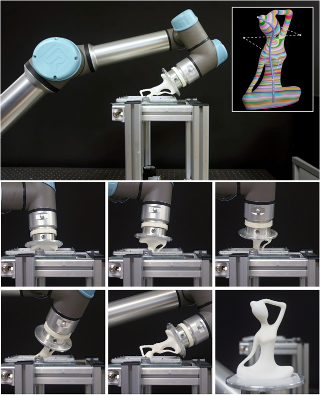
Neural Slicer for Multi-Axis 3D Printing

Published in ACM Transactions on Graphics (TOG), 2024

Tao LIU, Tianyu Zhang, Yongxue Chen, Yuming Huang, Charlie Wang

Neural Slicer for Multi-Axis 3D Printing

We introduce a novel neural network-based computational pipeline as a representation-agnostic slicer for multi-axis 3D printing. This advanced slicer can work on models with diverse representations and intricate topology. The approach involves employing neural networks to establish a deformation mapping, defining a scalar field in the space surrounding an input model. Isosurfaces are subsequently extracted from this field to generate curved layers for 3D printing. Creating a differentiable pipeline enables us to optimize the mapping through loss functions directly defined on the field gradients as the local printing directions. New loss functions have been introduced to meet the manufacturing objectives of support-free and strength reinforcement. Our new computation pipeline relies less on the initial values of the field and can generate slicing results with significantly improved performance.

Co-first Author

Curve-Based Slicer for Multi-Axis DLP 3D Printing

Published in ACM Transactions on Graphics, 2025 (Best Paper Award)

Chengkai Dai, Tao LIU, Dezhao Guo, Binzhi Sun, Guoxin Fang, Yeung Yam, Charlie C. L. Wang

Curve-Based Slicer for Multi-Axis DLP 3D Printing

This paper introduces a novel curve-based slicing method for generating planar layers with dynamically varying orientations in digital light processing (DLP) 3D printing. Our approach effectively addresses key challenges in DLP printing, such as regions with large overhangs and staircase artifacts, while preserving its intrinsic advantages of high resolution and fast printing speeds. We formulate the slicing problem as an optimization task, in which parametric curves are computed to define both the slicing layers and the model partitioning through their tangent planes. These curves inherently define motion trajectories for the build platform and can be optimized to meet critical manufacturing objectives, including collision-free motion and floating-free deposition. We validate our method through physical experiments on a robotic multi-axis DLP printing setup, demonstrating that the optimized curves can robustly guide smooth, high-quality fabrication of complex geometries.

Can Any Model Be Fabricated? Inverse Operation Based Planning for Hybrid Additive-Subtractive Manufacturing

Published in ACM Transactions on Graphics, 2025

Yongxue Chen, Tao LIU, Yuming Huang, Weiming Wang, Tianyu Zhang, Kun Qian, Zikang Shi, Charlie C. L. Wang

Can Any Model Be Fabricated? Inverse Operation Based Planning for Hybrid Additive-Subtractive Manufacturing

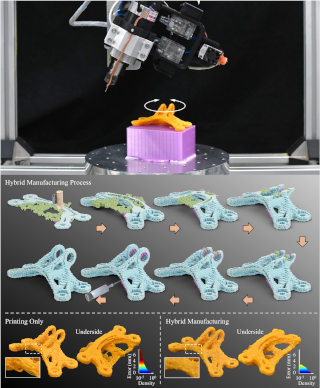
This paper presents a method for computing interleaved additive and subtractive manufacturing operations to fabricate models of arbitrary shapes. We solve the manufacturing planning problem by searching a sequence of inverse operations that progressively transform a target model into a null shape. Each inverse operation corresponds to either an additive or a subtractive step, ensuring both manufacturability and structural stability of intermediate shapes throughout the process. We theoretically prove that any model can be fabricated exactly using a sequence generated by our approach. To demonstrate the effectiveness of this method, we adopt a voxel-based implementation and develop a scalable algorithm that works on models represented by a large number of voxels. Our approach has been tested across a range of digital models and further validated through physical fabrication on a hybrid manufacturing system with automatic tool switching.

Toolpath generation for high density spatial fiber printing guided by principal stresses

Published in Composites Part B: Engineering, 2025

Tianyu Zhang, Tao LIU, Neelotpal Dutta, Yongxue Chen, Renbo Su, Zhizhou Zhang, Weiming Wang, Charlie Wang

Toolpath generation for high density spatial fiber printing guided by principal stresses

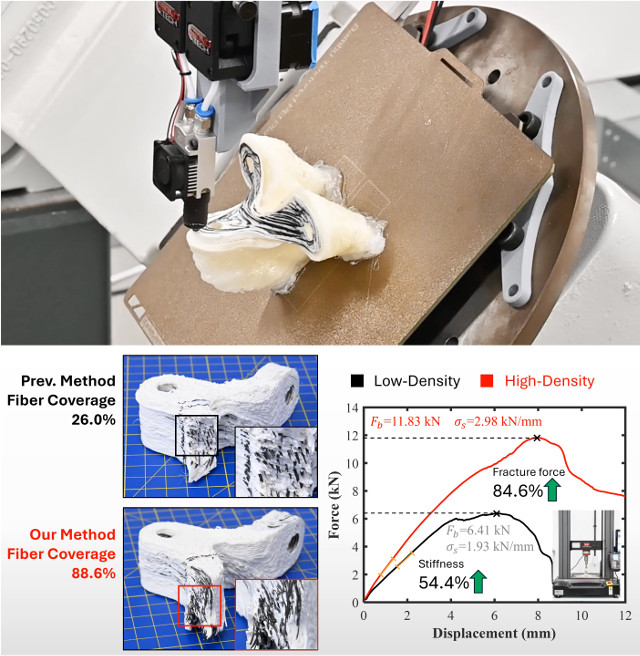
While multi-axis 3D printing can align continuous fibers along principal stresses in continuous fiber-reinforced thermoplastic (CFRTP) composites to enhance mechanical strength, existing methods have difficulty generating toolpaths with high fiber coverage. This is mainly due to the orientation consistency constraints imposed by vector-field-based methods and the turbulent stress fields around stress concentration regions. This paper addresses these challenges by introducing a 2-RoSy representation for computing the direction field, which is then converted into a periodic scalar field to generate partial iso-curves for fiber toolpaths with nearly equal hatching distance. To improve fiber coverage in stress-concentrated regions, such as around holes, we extend the quaternion-based method for curved slicing by incorporating winding compatibility considerations. Our proposed method can achieve toolpaths coverage between 87.5% and 90.6% by continuous fibers with 1.1 mm width. Specimens fabricated using our toolpaths show up to 84.6% improvement in failure load and 54.4% increase in stiffness when compared to the results obtained from multi-axis 3D printing with sparser fibers.

Supervisor First Author (Second Author)

Variational progressive-iterative approximation for RBF-based surface reconstruction

Published in The Visual Computer, 2021

Shengjun LIU, Tao LIU, Ling Hu, Yuanyuan Shang, Xinru Liu

Variational progressive-iterative approximation for RBF-based surface reconstruction

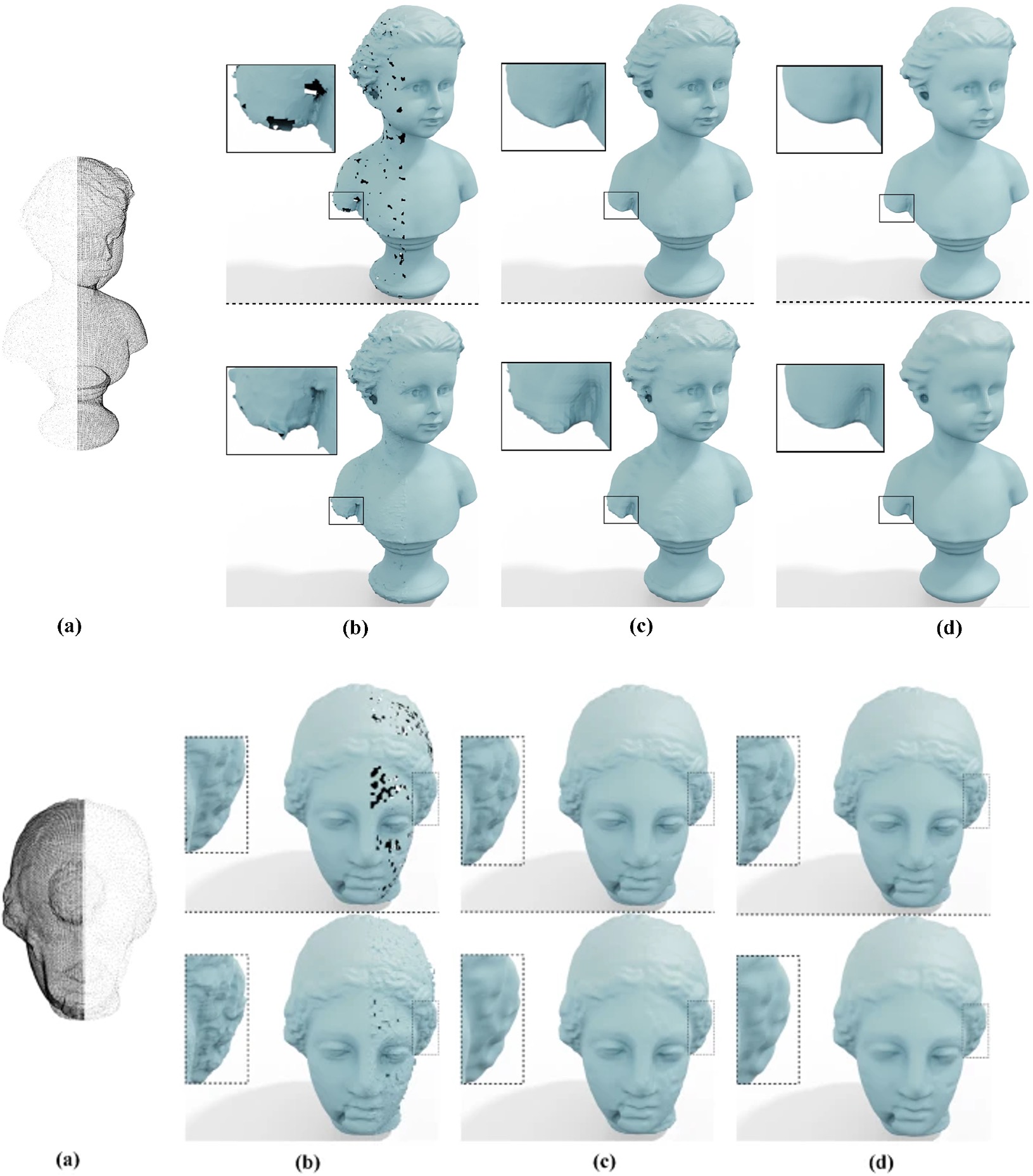
RBF-based methods play a very important role in the point cloud reconstruction field. However, solving a linear system is the bottleneck of such methods, especially when there are a large number of points and lead the computing to be time-consuming and unstable. In this paper, we firstly construct a novel implicit progressive-iterative approximation framework based on RBFs, which could elegantly reconstruct curves and surfaces or even higher dimensional data in an approximation or interpolation way, avoiding expensive computational cost on solving linear systems. Then, we further accelerate the proposed method with a strategy inspired from the conjugate gradient algorithm. In our framework, using proper RBFs allows to simply transform the iteration matrix to be symmetrical and positive definite. Such a property contributes to reduce the computational cost greatly and produce high-quality reconstruction results. Plenty of numerical examples on various challenging data are provided to demonstrate our efficiency, effectiveness, and superiority to other methods.

Memory-efficient modeling and slicing of large-scale adaptive lattice structures

Published in Journal of Computing and Information Science in Engineering, 2021

Shengjun LIU, Tao LIU, Qiang Zou, Weiming Wang, Eugeni L Doubrovski, Charlie CL Wang

Memory-efficient modeling and slicing of large-scale adaptive lattice structures

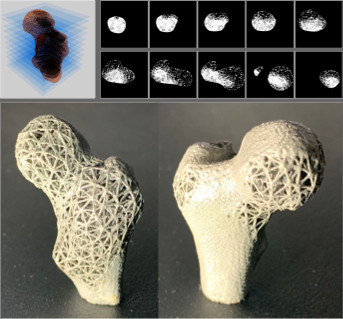
Lattice structures have been widely used in various applications of additive manufacturing due to its superior physical properties. If modeled by triangular meshes, a lattice structure with huge number of struts would consume massive memory. This hinders the use of lattice structures in large-scale applications (e.g., to design the interior structure of a solid with spatially graded material properties). To solve this issue, we propose a memory-efficient method for the modeling and slicing of adaptive lattice structures. A lattice structure is represented by a weighted graph where the edge weights store the struts’ radii. When slicing the structure, its solid model is locally evaluated through convolution surfaces in a streaming manner. As such, only limited memory is needed to generate the toolpaths of fabrication. Also, the use of convolution surfaces leads to natural blending at intersections of struts, which can avoid the stress concentration at these regions. We also present a computational framework for optimizing supporting structures and adapting lattice structures with prescribed density distributions. The presented methods have been validated by a series of case studies with large number (up to 100 M) of struts to demonstrate its applicability to large-scale lattice structures.

Other

Force-Based Adaptive Deposition in Multi-Axis Additive Manufacturing: Low Porosity for Enhanced Strength

Published in Robotics and Computer-Integrated Manufacturing, 2026

Yuming Huang, Renbo Su, Kun Qian, Tianyu Zhang, Yongxue Chen, Tao LIU, Guoxin Fang, Weiming Wang, Charlie Wang

Force-Based Adaptive Deposition in Multi-Axis Additive Manufacturing: Low Porosity for Enhanced Strength

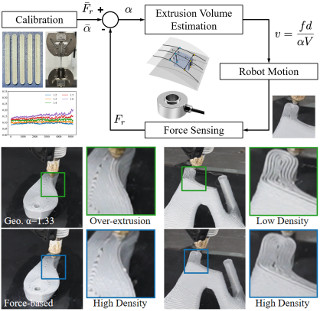
Multi-axis additive manufacturing enhances mechanical strength by aligning printed layers with principal stress directions. However, this benefit introduces a key challenge: non-uniform layer thickness becomes inevitable due to surface curvature and deposition angle variations. Moreover, unpredictable errors in material deposition – such as inaccurate extrusion control, collapse of earlier deposited layers, or machine malfunctions – can accumulate throughout the build. These issues are difficult to model accurately in advance, making purely offline planning impractical for ensuring consistent print quality, especially in complex geometries. To address this issue, we propose a force-based adaptive deposition method that actively minimizes porosity during filament-based multi-axis AM. Our closed-loop control strategy dynamically adjusts the printhead’s motion speed based on real-time force feedback, while maintaining constant extrusion speed. Unlike geometry-driven offline planning approaches, our method compensates for thickness variation and process uncertainties, resulting in improved filament bonding. Experiments show up to a 72.1% increase in failure load compared to baseline methods, with similar or lower part weights. The approach also enhances robustness against extrusion irregularities, ensuring more consistent mechanical performance.

Roadmap on Artificial Intelligence-Augmented Additive Manufacturing

Published in Advanced Intelligent Systems, 2025

Ali Zolfagharian, Liuchao Jin, Qi Ge, Wei-Hsin Liao, Andrés Díaz Lantada, Francisco Franco Martínez, Tianyu Zhang, Tao LIU, Charlie C. L. Wang, and others

Roadmap on Artificial Intelligence-Augmented Additive Manufacturing

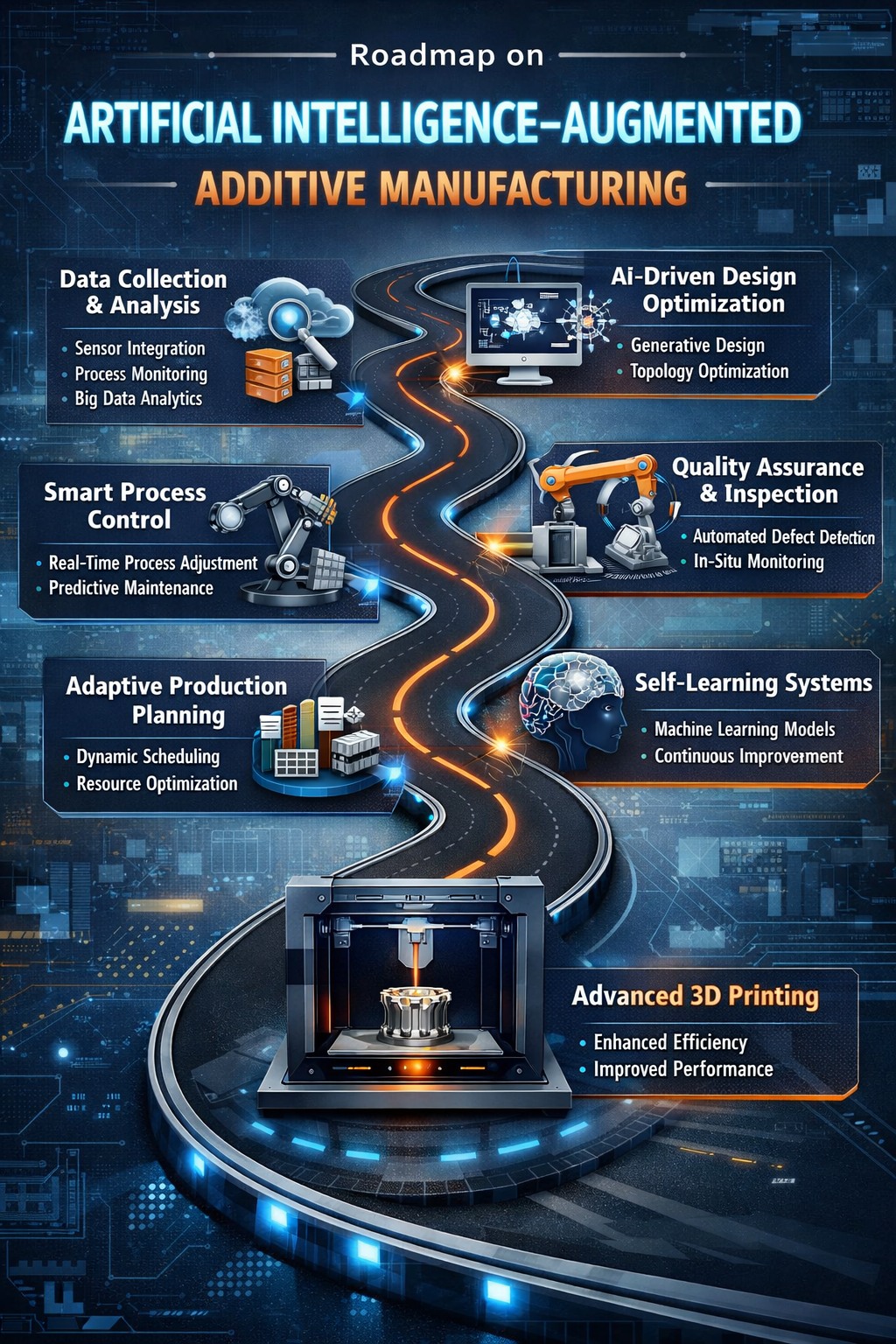
Artificial intelligence-augmented additive manufacturing (AI2AM) represents a transformative frontier in digital fabrication, where artificial intelligence (AI) is embedded not as a peripheral tool, but as a central framework driving intelligent, adaptive, and autonomous additive manufacturing (AM) systems. The objective of this Roadmap is to present a comprehensive vision of the state-of-the-art developments in AI2AM while charting the future trajectory of this rapidly emerging field. As AM applications continue to expand across diverse sectors, conventional design and control strategies face growing limitations in scalability, quality assurance, and material complexity. AI uses tools like computer vision, generative design, and large language models to help solve problems in scalability, quality assurance, and material complexity, allowing for real-time defect detection, digital twin integration, and closed-loop process control. This roadmap brings together leading contributions from twenty internationally recognized research groups by uniting perspectives from materials science, computer science, robotics, and manufacturing. This work aims to create a cohesive framework for advancing AI2AM as a multidisciplinary science. The ultimate intent of this work is to establish a foundation for coordinated research and innovation in AI-powered AM and to serve as a strategic entry point for future breakthroughs in autonomous and sustainable production.

Co-Optimization of Tool Orientations, Kinematic Redundancy, and Waypoint Timing for Robot-Assisted Manufacturing

Published in IEEE Transactions on Automation Science and Engineering, 2025

Yongxue Chen, Tianyu Zhang, Yuming Huang, Tao LIU, Charlie Wang

Co-Optimization of Tool Orientations, Kinematic Redundancy, and Waypoint Timing for Robot-Assisted Manufacturing

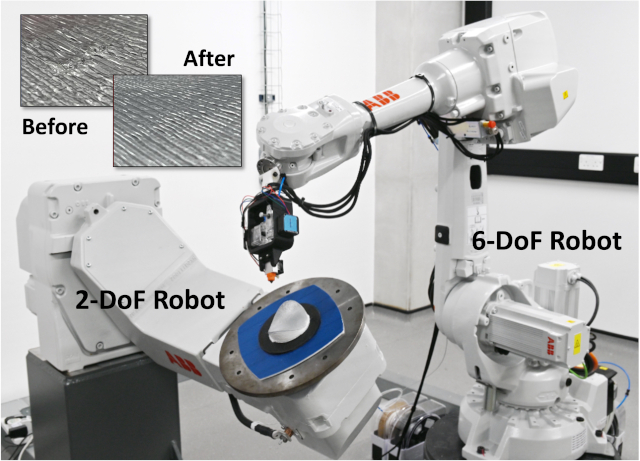
In this paper, we present a concurrent and scalable trajectory optimization method to improve the quality of robot-assisted manufacturing. Our method simultaneously optimizes tool orientations, kinematic redundancy, and waypoint timing on input toolpaths with large numbers of waypoints to improve kinematic smoothness while incorporating manufacturing constraints. Differently, existing methods always determine them in a decoupled manner. To deal with the large number of waypoints on a toolpath, we propose a decomposition-based numerical scheme to optimize the trajectory in an out-of-core manner, which can also run in parallel to improve the efficiency. Simulations and physical experiments have been conducted to demonstrate the performance of our method in examples of robot-assisted additive manufacturing.

Learning Based Toolpath Planner on Diverse Graphs for 3D Printing

Published in ACM Transactions on Graphics (TOG), 2024

Yuming Huang, Yuhu Guo, Renbo Su, Xingjian Han, Junhao Ding, Tianyu Zhang, Tao LIU, Weiming Wang, Guoxin Fang, Xu Song, and others

Learning Based Toolpath Planner on Diverse Graphs for 3D Printing

This paper presents a learning based planner for computing optimized 3D printing toolpaths on prescribed graphs, the challenges of which include the varying graph structures on different models and the large scale of nodes & edges on a graph. We adopt an on-the-fly strategy to tackle these challenges, formulating the planner as a Deep Q-Network (DQN) based optimizer to decide the next ‘best’ node to visit. We construct the state spaces by the Local Search Graph (LSG) centered at different nodes on a graph, which is encoded by a carefully designed algorithm so that LSGs in similar configurations can be identified to re-use the earlier learned DQN priors for accelerating the computation of toolpath planning. Our method can cover different 3D printing applications by defining their corresponding reward functions. Toolpath planning problems in wire-frame printing, continuous fiber printing, and metallic printing are selected to demonstrate its generality. The performance of our planner has been verified by testing the resultant toolpaths in physical experiments. By using our planner, wire-frame models with up to 4.2k struts can be successfully printed, up to 93.3% of sharp turns on continuous fiber toolpaths can be avoided, and the thermal distortion in metallic printing can be reduced by 24.9%.

Implicit progressive-iterative algorithm of curves and surfaces with compactly supported radial basis functions

Published in Journal of Computer-Aided Design & Computer Graphics, 2021

Haibo Wang, Tao LIU, Shengjun Liu, Wenyan Wei, Xinru Liu, Pingbo Liu, Yanyu Bai, Yue'an Chen

Implicit progressive-iterative algorithm of curves and surfaces with compactly supported radial basis functions

To reconstruct curves and surfaces robustly from scattered data,an implicit progressive-iterative algo-rithm with compactly supported radial basis functions based on the variational quasi-interpolation method is pro-posed.Firstly,the non-zero constraint of the implicit function is constructed using normal vectors at the given points,an iterative scheme for calculating coefficients of the implicit function is developed and its convergence is discussed.Secondly,by introducing an acceleration factor,the implicit progressive-iteration algorithm is sped up,and the convergence is analyzed.Finally,the accelerated algorithm is modified to decrease the space and time complexity.Numerical experiments show that the algorithm is effective for curve and surface reconstruction,and it also achieves good results for reconstructing from data with missing samples,non-uniform distribution,and noises.Moreover,it is simple to implement and easy to process in parallel.